National Defence
Symbol of the Government of Canada

Standing Orders - Chapter 8
Dress

801. General

1. Policies and instructions for wearing Canadian Forces uniforms are contained in A-AD-265-000/AG-001 (CFP 265), Canadian Forces Dress Instructions, the primary authority in matters of dress. This chapter is intended only to provide a ready reference and to amplify detail concerning items of dress which are particular to The Royal Regiment of Canadian Artillery.

2. All references to dress in this chapter shall be in accordance with the categories of dress detailed in CFP 265. These categories are:

    a. ceremonial dress;

    b. Mess Dress;

    c. Service Dress;

    d. operational dress; and

    e. occupational dress.


802. Ceremonial Dress

1. Within the category of Ceremonial Dress there are three orders. Dress order 1 and 1A are based on service dress with weapons, medals and ceremonial accoutrements as detailed in CFP 265. Dress order 1B encompasses all patterns of full dress uniforms.

2. The following distinctive patterns of artillery ceremonial dress may be worn on appropriate occasions:

    a. Regimental Full Dress RCHA;

    b. Regimental Full Dress RCA;

    c. RCA Band Parade Dress;

    d. RCA Band Concert Dress; and

    e. historical period dress.


803. Regimental Full Dress General

1. Details of both RCHA and RCA Full Dress may be found in The Dress Regulations for the Officers of the Canadian Militia 1907 and its amendments. These have been assembled in a publication of the New Brunswick Museum, Canadian Militia Dress Regulation 1907 (1977). This volume is held in many libraries. Assistance may be requested from the office of the Director of Artillery or from the Regimental Major.

2. The RCA Regimental Fund owns a number of RCHA and RCA Full Dress uniforms. These uniforms may be loaned to units for wear on appropriate occasions. Maintenance of these uniforms is the responsibility of the unit to which the uniforms are on loan. Any restoration or new purchases must be to the standards of these Standing Orders and as described in the Dress Regulations 1907 and amendments. All new uniforms shall become the property of the RCA Regimental Fund.

3. Regimental Full Dress may be worn on ceremonial occasions only. It may be worn by formed units or sub-units, Quarter guards or ceremonial gun detachments or by individuals acting as sentries, doormen and escorts for VIP visits, guest nights or other formal occasions. CFP 265 provides further details on occasions for wear.


804. Regimental Full Dress – RCHA

Dress 1B.1. The pattern of full dress was introduced in 1905. It is similar to RHA Full Dress with a dark blue tunic with scarlet collar, gold braid and lace, silver collar grenades and gilt buttons. Gold cap lines are worn with the busby, which has a white ostrich plume with red base. The red feathers at the base of the plume form the distinguishing feature from RHA Full Dress. (see Figure 11)

2. Both officer and NCM versions exist, the main difference being in gold wire accoutrements for officers and wool worsted gold braid for NCMs. The wearing of RCHA Full Dress is restricted to RCHA units and sub-units. The correct designation of this dress for the purpose of parade instructions or orders is Order of Dress 1B (RCHA).


805. Regimental Full Dress – RCA

Dress 1B1. This uniform is described in the 1907 Dress Regulations. It consists of a dark blue tunic and trousers with scarlet collar, piping, shoulder straps and trouser stripe. The uniform is appointed with gold lace, braid, pouch belt, waist belt and sword slings. A black patent pouch with gilt badge is also worn (see Figure 12).

2. RCA Full Dress may be worn on ceremonial occasions by RCA units. Artillery Bands may also wear this uniform. The correct designation of this dress for the purposes of parade instructions or orders is Order of Dress 1B (RCA).


806. RCA Band Parade Dress

Dress 1B BandThe RCA Band has been authorized to acquire and wear the Artillery Band Parade Dress on parade and other ceremonial occasions. This uniform is a modified version of the original uniform worn by both the RCA and RCHA bands up to 1968 (see Figure 13). In the 1980’s the RCA Band wore a modified version of Dress 1B (RCA). In 1997, the Colonel Commandant and the Director of Artillery, in conjunction with advice from the directorate of History and Heritage, decided that a return to the original uniform would be authorized. The existing band uniforms were in poor shape, and the colours used in the old uniforms could not be matched with newer materials. With the Centennial of the band fast approaching, it was decided that new uniforms would be acquired, using the historical pattern to give the band a distinctive look. This uniform is maintained partially at public expense and partially by non-public funds. The correct designation of this dress for the purposes of parade instructions or orders is Order of Dress 1B (Band Parade).


807. RCA Band Concert Dress

Dress 1B Band ConcertThe RCA Band is also authorized to wear the RCA Band Concert Dress at formal concerts, guest nights and similar occasions. This uniform is shown at Figure 14. This uniform is purchased and maintained by a combination of public and non-public funds. The correct designation of this dress for the purposes of parade instructions or orders is Order of Dress 1B (Band Concert).


808. RCA Band Accoutrements

1. Bandsmen were traditionally armed with a short sword. Artillery bands so desiring may wear the Sword and Scabbard, Drummers Mark II, 1902 pattern. The sword has a brass hilt, a 13.1 inch blade with a total length of 18.4 inches. The Royal Cypher is incorporated into the hilt. The scabbard is brass mounted black leather. Approved alternates to the formal band sword are either the 1907 pattern bayonet for the Long Lee Enfield suitably chromed or the Snider-Enfield sword bayonet.

2. Additional band accoutrements may include capes, music pouches and a drum major’s sash. Details are available from the Director of Artillery or the Regimental Major.


809. Historical Period Dress

1. Certain ceremonies may incorporate historical re-enactments or the display of artillery weapons when uniforms representative of the period may be appropriate. While these uniforms do not all fall within the category of ceremonial dress, regulations for their wear are included here because of the ceremonial nature of the displays.

2. CFP 265 sets out the conditions under which former patterns of Service and Ceremonial Dress uniforms may be worn in Articles 2.16.2 and 10.05. Except for Mess Dress, former Canadian Army patterns of uniform shall not be worn by members of the Regular Force except members of Canadian Forces Bands and personnel participating in special events as authorized by the commander of a command or the NDHQ equivalent. Members of the Reserve Force may wear such uniforms when ordered.

3. Permission to wear these uniforms would normally be restricted to occasions illustrating the historical traditions and heritage of the Regiment such as tattoos, dedications of colours or historical re-enactments.

4. Some examples of historical period dress under this heading include:

    a. Battle Dress with 25 pdr;

    b. WW I uniform with 18 pdr;

    c. Boer War khaki with 12 pdr;

    d. RCHA Patrol Dress;

    e. RCA Patrol Dress; and

    f. uniforms of the Loyal Company.


810. Mess Dress

Mess dress1. The Mess Dress of The Royal Regiment of Canadian Artillery is a variation of the Army pattern approved in 1986 and is known as the “Artillery Pattern Mess Dress” (see Figure 14). It is No 2 order of dress. All previous patterns of Mess Dress are obsolete. Members of the Regiment who possess former patterns of Mess Dress are permitted to wear them under the following “grandfather clauses” which will remain effective until the member retires or until the uniform must be replaced:

    a. officers commissioned in the Canadian Army prior to 1 February 1968 may continue to wear their former Army Pattern Artillery Mess Dress;

    b. members who purchased a CF Midnight Blue Mess Dress (No 2D) shall be permitted to continue to wear that uniform;

    c. members who purchased the scarlet pattern (No 2F) (formerly known as CM-1) shall be permitted to wear that uniform; and

    d. female members have the choice of wearing the skirt in place of trousers.

Mess dress2. Artillery Pattern Mess Dress. This Mess Dress (No 2) was authorized in FMC 5250-2 (Comd) 23 October 1986. It is based on the Army pattern which consists of a scarlet jacket with shawl collar, midnight blue trousers and midnight blue waistcoat. Regimental detail is based on facings, collars and cuffs in midnight blue and a broad scarlet stripe on the trousers (Figure 13). On the skirt the scarlet stripe is the same width as on the trousers, but is limited to bordering both edges of the side slits (Figure 16). Detailed specifications are available from the Director of Artillery or the Regimental Major. Generally, specifications for the RCA Pattern Mess Dress are as follows:

    a. Policy. Wear is approved for all ranks except as indicated below;

    b. Jacket

      (1) Material

        (a) officers/CWOs - scarlet doeskin, and

        (b) NCMs - scarlet barathea or doeskin,

      (2) Design. Buttonless, simple breasted body with shawl lapels and surgeon cuffs,

      (3) the colour for lapels, shoulder straps and cuffs is midnight blue (doeskin or barathea to match the material use in the jacket body),

      (4) senior officers wear crowsfoot sleeve embellishment, junior officers and CWOs do not wear cuff embellishments, as indicated in CFP 265, Chapter 10,

      (5) artillery buttons (26 ligne) are used on the epaulettes only,

      (6) badges, accoutrements and CF rank insignia of gold wire pattern is worn. NCMs shall wear gold wire insignia with midnight blue backing. Officers shall use single braid available from the supply system. Gold wire grenade collar badges and scarlet backed hazardous skill badges are worn, and

      (7) miniature medals/decorations are worn;

    c. Waistcoat. Waistcoat is of midnight blue doeskin or barathea and uses four 20 ligne buttons;

    d. Trousers

      (1) trousers, skirts and overalls are of midnight blue barathea. Overalls have a high english back, and

      (2) the trouser/overall stripe is 1.5” scarlet barathea, and

      (3) the skirt stripe is scarlet barathea, and is limited to bordering both edges of the side slits;

    e. Shirt/blouse

      (1) Males (optional for Females). Pleated front, turn down collar and French cuffs. Wingtip collars are not authorized,

      (2) Females. Blouse white long sleeved with gold buttoned front closure and high collar, no bow tie,

      (3) studs are regimental pattern (RCA/RCHA) or plain gold, and

      (4) cufflinks are regimental pattern (RCA/RCHA);

    f. Bow Tie. Bow tie is black, 4.75" in length by 1.5" at the squared ends;

    g. Footwear. Wellington boots if wearing overalls and may wear shoes if wearing trousers. For females, pumps may be worn with the skirt;

    h. Spurs. Stainless steel gooseneck spurs are worn with overalls. Spurs are not worn on board HM ships, while dancing, or with straight trousers; and

    Mess dressi. White summer jacket

      (1) is similar in design to the No 2F scarlet jacket, with the exception that the front is closed by a pair of 30 ligne artillery buttons, and that senior officers do not wear the gold crow’s foot embellishment on the sleeves. It may be worn as optional summer dress by officers and CWOs only (see Figure 17),

      (2) an artillery pattern cummerbund will be worn,

      (3) the shoulder straps are white with 26 ligne artillery buttons,

      (4) badges, accoutrements and CF rank insignia of gold wire pattern is worn. CWOs shall wear gold wire insignia with midnight blue backing. Officers shall use single braid available from the supply system. Gold coloured metal grenade collar badges and miniature (if available) metal hazardous skill badges are worn, and

      (5) Miniature medals/decorations are worn;

    j. Gloves. White gloves as required.

3. No 2B (Mess Service). This is an optional mess dress uniform for wear in preference to No 3 order of service dress on occasions when mess dress would be considered appropriate. This uniform consists of the service dress tunic and trousers with a plain white shirt and black bow tie. Details are available in CFP 265. The following personnel may wear it:

    a. newly commissioned Regular or Reserve Officers during the six months accorded them to obtain mess dress;

    b. officer cadets; and

    c. non-commissioned members of both Regular and Reserve Forces.

4. The supply cataloguing information for artillery mess dress cloth is:

Scarlet 8305-21-876-0623 Cloth Tropical, Wool/Polyester 203 g/sq m Scarlet (SP No DCGEM 255-77) Plain or scarlet superfine english doeskin (650 g/sq m) for officers and either doeskin or a scarlet barathea cloth for NCOs mess dress.


811. Army Service Dress

1. Head Dress. The rifle green beret shall be worn with all orders of dress by all members of The Royal Regiment of Canadian Artillery, except when they are entitled or required to wear the maroon beret or the blue United Nations beret.

2. Army service dress will be worn with artillery buttons, collar badges, cap badge, shoulder titles, and narrow web belt.

3. Artillery accoutrements are issued to officer cadets on the commencement of their second phase of training at the Artillery School and to recruits on graduation from QL 3 training at the RCA Battle School.

4. Artillery Buttons. Gold coloured half-round artillery buttons with the RCA crest are worn as follows:

    a. front of jacket - 30 ligne buttons;

    b. jacket pockets - 26 ligne buttons;

    c. epaulettes - 26 ligne buttons; and

    d. fur hat - 30 ligne buttons.

5. Collar Badges. Gold coloured badges consisting of a grenade of seven flames and the motto “UBIQUE” are worn on the collar of the service dress jacket. The badges are 13" high by e” wide. The collar badges are worn centred on the stitching of the collar/lapel seam with the base of the badge parallel to the ground and with the collar/lapel seam passing diagonally under the centre of the collar badge. (see diagram at Annex A).

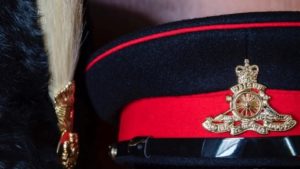
6. Small Cap Badge. An embroidered artillery badge, 1.5" high and 1.75" wide (Insignia Embroidered Officers RCA), will be worn by officers and Chief Warrant Officers on the CF green beret and the Canex fur hat. All others wear a gold plated artillery badge 1.5" high and 1.75" (Insignia Service Cap, The RCA, 1953) on the beret and Canex fur hat.

7. Shoulder Titles. Artillery shoulder titles are available in metal for wear with service dress jackets and cloth for wear with slip-ons. They shall be worn as follows:

    a. members of RCHA units will wear RCHA/RALC on both the army service dress jacket (metal) and slip-ons (cloth);

    b. in accordance with long standing custom, officers serving on the staff of the Royal Military College of Canada may retain their RCHA/RALC distinction if posted directly from a RCHA unit; and

    c. all others shall wear RCA or ARC on both the army service dress jacket (metal) and slip-ons (cloth).

8. Since shoulder titles are approved in both English and French versions, the choice of language will be determined as follows:

    a. for personnel on regimental duty, as directed by the CO;

    b. for personnel ERE, as a matter of individual choice;

    c. regimental duty as used above includes field and air defence regiments, independent field and air defence batteries, the Royal Canadian Artillery School; and

    d. the wearing of mixed English and French shoulder titles on the same order of dress shall not be permitted.

9. Belts. The narrow black web belt is to be worn with all uniforms except combat dress. The brass buckle will be inscribed with the RCHA Badge for RCHA units, and the RCA badge for all others. The belt shall be fastened in such a manner as to ensure that not more than two inches of black belt material protrudes through the belt buckle. As such, the commencement of brass tip attached to the running end of belt will appear two inches to the right of the buckle as seen by the observer.

10. Occupational Badges. Occupational badges recognize advanced levels of trade profi- ciency. The designs are symbolic of the skills associated with field artillery, air defence artillery and locating artillery. The badges of the Master Gunners and Assistant Instructors-in-Gunnery recognize their role in the Regiment in the instruction and continuity of technical expertise. These badges are worn as detailed in CFP 265.


812. Operational Dress

1. The normal operational dress is combat clothing and will be worn as detailed in CFP 265 and local orders.

2. Shoulder titles. Abbreviated shoulder titles are to be worn on epaulettes as follows:

    a. RCHA units: RCHA/RALC respectively; and

    b. RCA, ARC or abbreviated unit title if approved (see Annex B, Chapter 1 for authorized shoulder identifiers).

3. Other forms of operational dress for specific theatres shall be worn as designated by operational commanders.


813. Ceremonial Accoutrements

Approved artillery ceremonial accoutrements include swords, sword slings, white waist belt with regimental buckle, canes and pace sticks.


814. Swords

1. Like the Sovereign’s Commission, the sword has long been the traditional hallmark of an officer. RSMs wear (but do not draw) swords as a mark of the special position of trust and responsibility which they hold. While today swords are an optional item of dress, their use on ceremonial occasions is encouraged.

2. As befits its traditions as a mounted corps, the sword of The Royal Regiment of Canadian Artillery is based upon the Light Cavalry Pattern of 1822. The grip is covered in sharkskin or simulated sharkskin and wire bound and the pommel is stepped.

3. The blade is slightly curved, single edged and spear pointed. In cross section, it conforms to the “Wilkinson” pattern with a wide fuller and no pipe back. The blade length may vary from 28 to 36 inches to conform to the wearer’s height. The blade is embossed on the obverse with the crown, cypher, “UBIQUE” motto and regimental badge. On the reverse is embossed “ROYAL CANADIAN” above bolts of lightning and either “ARTILLERY” or “HORSE ARTILLERY” beneath. Additional embossing in the spaces provided is at the owner’s discretion. The steel scabbard has two bands and loose rings.


815. Sword Slings and Sword Knots

Sword1. The gold cord sword knot is worn with the sword with Ceremonial Orders of Dress. The loop of the sword knot is passed through the slit in the rear of the hilt from the inside and from the left of the hilt as worn. The acorn is then passed through the loop and the cord or strap pulled tight. The slide of the cord is positioned midway between the acorn and the point at which the cord is attached to the hilt of the sword. The sword knot is permitted to hang free (see Figure 18). The approved pattern sword knot gold 17.5" is available under NSN 8465-21-104-7953.

2. With ceremonial orders of dress, the sword is carried by slings suspended from a woven belt worn under the tunic (NSN 8465-21-104-7759 sword belt, red canvas). The slings are crimson Russia leather one inch wide with plain gold lace .875" wide and lion head buckles. The sword is always worn at the full extent of the slings and is never hooked up. Slings may be purchased from the RCA Kit Shop.


816. White Waist Belt

1. For ceremonial parades, non-commissioned members are to wear the Canadian Forces ceremonial belt (NSN 9390-21-591-2013) with Ceremonial Orders 1 and 1A and other Ceremonial Orders as ordered. The belt shall be worn with the large regimental buckle.

2. RSMs shall wear their sword carried on a white sword belt (NSN 8440-21-888-7416) with the large regimental buckle. This belt is worn outside the tunic.

3. Buckles may be obtained from the RCA Kit Shop.


817. Canes and Pace Sticks

1. Regimental Sergeants-Majors should carry CF pace sticks or canes of approved regimental pattern. Battery Sergeants-Majors should carry canes of approved regimental pattern in accordance with Chapter 3 of A-AD-265-000/AG-001.

2. Instructors, while teaching drill, may carry a drill cane. The RCA Kit Shop has approved drill canes available for purchase.


818. Instructors-in-Gunnery and Assistant Instructors-in-Gunnery

1. Instructors-in-Gunnery, when on instructional duty at schools of artillery or on artillery ranges in an Instructor-in-Gunnery capacity, will wear the former army khaki forage cap with a red band and large old brass artillery cap badge when wearing combat clothing and garrison dress.

2. Assistant Instructors-in-Gunnery will, when similarly employed, wear a white cover on the CF green peaked cap with a red band and large brass artillery cap badge.


819. Regimental Tie

1. The regimental tie is navy blue with red zig-zag stripes running downward from left to right as worn. The regimental tie is worn with civilian clothes. The design is representative of the lightning bolts associated with St. Barbara.

2. The Royal Canadian Horse Artillery Brigade Association in Kingston, which perpetuates the long connection of the Regiment with that city, is authorized to use the tie in regimental colours with double crimson zig-zag stripes. This tie was authorized for wear by members of the permanent force horse artillery before the Second World War and its wear is restricted to members of the Royal Canadian Horse Artillery Brigade Association.

3. Master Gunners, serving and retired, are authorized to wear their authorized tie. It is blue in colour, with one crimson zig-zag at the bottom and a stylized “MG” in the centre.

4. No other ties are officially recognized as regimental or artillery ties.


820. Regimental Scarf

The Regimental Scarf is of the same material as the regimental tie.


821. Regimental Blazer

Traditionally, the regimental blazer has been of navy blue flannel, worsted or barathea cloth and either single or double-breasted. Today, it is more common to find the material used is a navy blue polyester/wool hopsack type. The Royal Canadian Artillery or Royal Canadian Horse Artillery crest is mounted on the left breast pocket. The buttons are half round, of gilt, and engraved or superimposed with the RCA or RCHA badge. RCA and RCHA crests are available from the RCA Kit Shop. Individuals may wear the RCHA crest instead of the RCA Crest if they have served at least once in an RCHA unit during their careers.


822. Wearing of Medals and Insignia

The wearing of orders, medals and insignia with uniform is as detailed in CFP 265. The wearing of orders, medals and insignia on civilian clothing is summarized in the publication, A Guide to the Wearing of Orders, Decorations and Medals. This publication may be ordered from:

The Chancellery of Canadian Orders and Decorations Government House Ottawa, Canada K1A 0A1

823. The Artillery Lanyard

1. Lanyards developed as an article of military kit as armies adopted khaki uniforms and accoutrements for campaign purposes. Pistol lanyards and sword knots were used to prevent the loss of weapons. It was also found convenient to have a shoulder lanyard to secure whistles and clasp knives. These items had practical uses in mounted units for signalling, in the case of the whistle, and for emergency repair to kit and guns, and care of horses and harness, in the case of the clasp knife. In an emergency, the shoulder lanyard was the correct length and strength to be used as a firing lanyard.

2. Although issue lanyards were khaki in colour, Commanding Officers were allowed to take other patterns into wear provided unit uniformity was maintained. The Royal Regiment of Canadian Artillery adopted the distinctive white lanyard prior to WW I. Originally worn on the left shoulder, the lanyard was transferred to the right shoulder to avoid conflict with the cartridge cross belt then in use. The white lanyard, scrupulously cleaned, became a symbol of pride to all gunners. Other corps and regiments tended to discontinue the use of coloured lanyards during operations. Gunners, however, took great pride in wearing the white lanyard in the heat of battle throughout WW I, WW II and the Korean Conflict.

3. The artillery lanyard was always knotted from a natural fibre-like cotton; the use of nylon or other synthetics was not acceptable. The lanyard was only awarded on successful completion of basic and corps training, marking full acceptance into the gunner family. All gunners, up to and including the rank of Warrant Officer (Staff Sergeant), wore the lanyard. In today’s forces, lanyards are no longer worn.


824. RCA Tracksuit

SwordThe RCA standard tracksuit is heavy weight, high quality, navy blue with RCHA Badge or RCA Badge emblazoned in gold on the left breast and left leg. Unit number designations will not appear on the suit (see figure 19). The RCA or RCHA versions of the tracksuit are acceptable wear on all artillery sports parades. The sole supplier is the RCA Kit Shop. Phase IV and QL 3 graduates will be given an initial issue of the RCA tracksuit at no charge upon graduation.

(825 to 899 inclusive - not allocated)


  • Annex A to Chapter 8 Positioning of Artillery Collar Badges on Service Dress
  • Standing Orders Chapter 9 Guest Nights