The Royal Regiment of Canadian Artillery follows, in general, standard forms of drill and ceremonial. However, the Regiment does lay claim to certain prerogatives and has preserved some unique traditions.
1. The honour of “The Right of the Line”, on an army parade, is held by the units of the Royal Canadian Horse Artillery when on parade with their guns. On dismounted parades, RCHA units take precedence over all other land force units except formed bodies of Officer Cadets of the Royal Military College representing their college. RCA units parade to the left of units of the Royal Canadian Armoured Corps. Details concerning precedence within the Canadian Forces are given in CFAO 61-6.
2. The artillery company of the Troupes de la Marine (formed in Quebec in 1750) was considered a “corps d’élite” and on parade took the position of honour at the right of the line. At about this time, the Royal Artillery was officially accorded the same honour.
3. It has not been clearly established exactly when the Royal Artillery was first given its position on the right of the line but it was very likely in Flanders about 1742-1748. It is recorded that in 1742, at a camp at Lexden Heath near Colchester, “The Artillery on its own authority, moved from the left of the camp to the right, which was its customary place.”
4. In 1756, the matter was brought to official notice on a complaint by a Capt Pattison, whose company of artillery was denied its usual place on the right during a parade to witness the execution of a deserter. He based his claim on the custom in Flanders. The claim was upheld and the official letter on the subject concluded as follows:
“It is the Duke of Cumberland’s order that Colonel Bedford write to Capt Pattison and acquaint General Bland, it is His Royal Highness’ command that the Artillery take the right of all foot on all parades and likewise of Dragoons when dismounted”.
5. In 1773, at Gibraltar, the Commander Royal Artillery protested that the governor had changed the accepted order of precedence in parading the Guards. The protest was then taken to His Majesty, who upheld the Gunners’ claim. The custom was again upheld in 1787 when it was questioned whether the Royal Irish Artillery should parade on the right or left of the Royal Military Artificers who were the next in order of precedence after the Royal Artillery. The answer to this question was: “The Royal Artillery to be on the right, either English or Irish, there is no exception.”
6. From its formation in 1793, the Royal Horse Artillery took precedence over all cavalry including the Household Cavalry, following the established precedence of the Foot Artillery over all infantry including the Foot Guards. This precedence was confirmed in 1804 but was modified by Queen Victoria in 1868 so that the Royal Horse Artillery when on parade with their guns would take precedence over the Household Cavalry, who otherwise held the right of the line as part of the Body Guard of the Sovereign.
7. Precedence within The Royal Regiment of Canadian Artillery is as outlined at article 104.
1. Instructions for both mounted and dismounted drill for all units of the Royal Regiment of Canadian Artillery are contained in A-PD-201-000/PT-000 Canadian Forces Manual of Drill and Ceremonial. The following traditional artillery drill practices will, however, be observed within the Regiment:
a. an artillery parade is always handed over “at ease”. This applies at all levels of command up to and including the commander of an artillery formation. However, artillery sub-units, units and formations will receive an inspecting officer at “attention”. This practice dates from the period before recoil mechanisms when guns had to be run back by hand into firing position. After hours of sponging, loading, firing and running the guns back into battery, the gunners were exhausted. Commanders extending their congratulations to gunners for their contribution to victory granted them the privilege of receiving these accolades “at ease” rather than “attention”. A parade will receive an inspecting officer at “attention”;
b. officers and men serving the weapons and equipment of the Regiment will carry out their duties at the double unless orders to the contrary are issued and except when handling ammunition; and
c. bayonets will be carried by Artillery personnel who are issued with rifles and bayonets. The artillery does not, as a matter of routine, fix bayonets except when ordered for ceremonial parades or when on guard, etc, with members of other branches or corps carrying fixed bayonets.
1. When gun salutes are fired in conjunction with Royal or General Salutes, the Royal or General Salute shall be conducted in its normal manner regardless of the fact that the gun salute is continuing.
2. When gun salutes are fired by The Royal Regiment in conjunction with Royal or General salutes, they should commence as the final movement of the “Present Arms” is performed. On all other occasions the firing shall be controlled and timed by the firing troop commander.
3. The form of the salute shall be governed by the overall parade format and the aural comfort of dignitaries and spectators. Particular attention must be paid to noise when horses are involved in the ceremonies.
4. The saluting troop should consist of four guns commanded by a Troop Commander with a Gun Position Officer and a Troop Sergeant Major. Kneeling gun drill shall be employed. The saluting troop should be deployed, if possible, in a prominent position and should be inspected by the Reviewing Officer during the parade.
5. Annex A to this chapter details a table of salutes accorded to important personages. Further regulations governing the firing of gun salutes on all occasions are detailed in CFAO 61-8 and A-PD-201-000/PT-000 Canadian Forces Manual of Drill and Ceremonial.
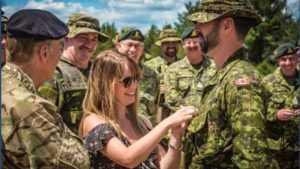
1. Military uniform is appropriate for wear by either or both of the marriage partners and members of the wedding party. Service dress (1 or 1A) may be worn. Members of the wedding party may wear swords in the church.
2. A sword arch is a traditional accompaniment for the wedding of a serviceperson, whether the wedding party is in uniform or not. The sword party consists of three or four pairs of fellow officers with one named to command the sword party. The sword party lines both sides of the departure walk in facing pairs with swords drawn. On the command “Form arch”, the sword is brought to the recover position and, after a regulation pause, the right arm is extended fully upward at a 45 degree angle. As the arm is extended, the wrist is rotated 270o counter-clockwise into the final position with the back of the sword facing down, the edge of the blade and the guard facing up. Following the passage of the wedding party, the movements are repeated in reverse order on the command “Attention”. Instructions for the drill movements for a sword arch are contained in A-PD-201-000/PT-000 Canadian Forces Manual of Drill and Ceremonial.
3. It is traditional for the bride and groom, after having passed under the arch of swords, to ride on a waiting gun limber from the church to the reception.
4. Wedding receptions take the usual form but the bride and groom may use a sword to cut the cake.
1. Since prehistoric times, kings and warriors have been borne to their graves with their weapons - Roman soldiers carried on their shields, Viking chieftains were dispatched on their burning longship and warrior knights buried with their horse. Two current funeral customs have their origins with these mystic beginnings - the riderless horse and the use of a gun carriage as a hearse.
2. A black horse saddled but with spurred boots reversed in the stirrups symbolized the soldier who will ride into battle no more. As a mounted corps, it is an appropriate custom for any artillery funeral.
3. Gun carriages with a special platform for accepting the casket have long been used at funerals. The gun may be with or without limber and drawn by hand, horse or vehicle. The most popular guns for this purpose are the 25 pounder and the 105-mm C1 because they have excellent stability and a reasonable height for the casket bearing platforms. Pallbearers march on either side of the gun carriage in the funeral procession. The use of a gun carriage for a hearse is not restricted to gunners but is customary for all military funerals.
4. CFAO 24-5 and A-PD-201-000/PT-000 Canadian Forces Manual of Drill and Ceremonial contain other details on military funerals.
1. Communication and Co-ordination. It is imperative that the Colonel Commandant, the Director of Artillery and RHQ RCA be promptly informed of the death of a serving or former member of The Royal Regiment of Canadian Artillery. OPIs, as listed below, are responsible to notify the Director of Artillery and the Regimental Major RCA in the event of such a death in their geographical area:
a. Land Force Atlantic Area. OPI. The Commandant Artillery School;
b. Land Force Quebec Area. OPI. The Commanding Officer 5 RALC;
c. Land Force Central Area. OPI. The Commanding Officer 2 RCHA;
d. Land Force Western Area. Less province of British Columbia. OPI. The Commanding Officer 1 RCHA;
e. British Columbia. OPI. The Commanding Officer 15 Field Regiment RCA;
f. Canadian Forces Northern Area. OPI. Senior Gunner Officer in CFNA HQ; and
g. Europe/USA. OPI. The Senior Gunner Officer on staff at CDLS (L)/CDLS(W) or an officer appointed by DArty.
2. All notices are to be forwarded to the respective OPI’s via their affiliated unit headquarters.
3. Upon notification of the death of a serving or former member of The Royal Regiment of Canadian Artillery, the Director of Artillery will effect liaison with the necessary authorities in NDHQ, or the Base Commander or Commanding Officer concerned, to ensure that Regimental representation and assistance are provided if required. Notifications will be promulgated to the Colonel Commandant, RHQ RCA and all artillery units for their information. RHQ RCA will then post a death notice on the RCA Web Site and publish it in the next Quadrant.
1. Although a unit change of command can be a simple office signing ceremony, it is traditional that a Regimental parade be held to mark the occasion. The Colonel Commandant should be invited to all such parades.
2. The following procedures should take place on parade:
a. the incoming commanding officer arrives with the reviewing officer and accompanies the reviewing officer as part of the inspecting party;
b. the regiment marches past once and reforms on the inspection line;
c. presentations, certificate signing and addresses take place:
(1) first, any presentations to other than the outgoing commanding officer,
(2) second, the outgoing commanding officer addresses his/her unit for the final time,
(3) third, the change of command certificates are signed (see para 3), followed by any presentations, such as the commanding officer’s pennant, etc, to the outgoing commanding officer, and
(4) last, an address is made by the reviewing officer, with the incoming commanding officer making a short reply to both addresses if circumstances warrant;
d. the regiment, under the incoming commanding officer, marches past the outgoing commanding officer;
e. the regiment advances in review order and pays compliments to the reviewing officer; and
f. the reviewing officer departs, accompanied by the outgoing commanding officer.
3. For the signing ceremony, the presiding officer, accompanied by the incoming commanding officer, takes up a position in front of the dais. The outgoing commanding officer proceeds forward and halts in front of the presiding officer, and the outgoing commanding officer salutes. The Commanding Officer’s Pennant is brought forward, usually by the driver or trumpeter, and given to the outgoing commanding officer who in turn presents it to the presiding officer. The incoming and outgoing commanding officers proceed to a table placed at one side of the dais and sign the change of command certificates, under the supervision of the presiding officer. The presiding officer then presents the incoming commanding officer with the Commanding Officer’s Pennant.
4. This type of ceremony should also be encouraged at the battery level with the changing of battery commanders.
1. The recent tradition of having the commanding officer pass the Regimental Cane from the outgoing RSM to the incoming RSM is encouraged by The Royal Regiment. This simple ceremony allows the commanding officer to charge the new RSM with carrying out the duties and responsibilities of the appointment with the unit as witness.
2. The drill should be simple in format. At the completion of a regimental parade the commanding officer should call forward the outgoing and incoming RSMs and exchange the Cane. After dismissing the outgoing RSM the commanding officer orders the new RSM to take up position on parade. Once the parade has been turned back to the RSM by the 2IC, the new RSM should march the regiment off the parade ground with the outgoing RSM on the dais at the position of attention.
3. This type of ceremony should also be encouraged at the battery level with the changing of BSMs.
(510 to 599 inclusive - not allocated)