National Defence
Symbol of the Government of Canada

Standing Orders - Chapter 4
Colours and Badges

401. General

1. The Royal Regiment of Canadian Artillery has been authorized to take into use a variety of pennants, flags and badges.

2. The use of these devices is limited to those authorized and described in this chapter.

3. Additional copies of the graphics of the badges shown herein are available from RHQ RCA.

402. The Royal Cypher

Royal Cypher1. In Great Britain, guns were originally inscribed with the “Founders Mark” of the private foundry that manufactured the guns. By contrast, in France, the arms of the reigning monarch were customarily inscribed on the barrels. As the Royal Ordnance Factory, whose mark was the Royal Cypher, became responsible for the manufacture of most British artillery, it became customary to inscribe the Royal Cypher on all guns.

2. When, in 1893, Queen Victoria conferred the title “Royal” on the artillery in Canada, the honour included the right to engrave on artillery equipment the Imperial Cypher VRI surmounted by the Imperial Crown. The honour is perpetuated today by inscribing the Royal Cypher of the reigning monarch on each artillery piece (see figure 1).

3. Instructions concerning the application of the Royal Cypher are found in Canadian Forces Technical Order (CFTO) C-71-010-021/MN 000.


403. Arms Of The Royal Regiment Of Canadian Artillery

1. Before 1832, the Royal Artillery used the Ordnance Arms or the Royal Cypher as part of the insignia on its buttons and badges. The Ordnance Arms had as their central devices three cannons and three cannonballs. The Royal Cypher consisted of either the garter and motto surmounted by a crown enclosing the monarch’s monogramme or the monarch’s monogramme alone surmounted by a crown.

Full Achievement2. In 1832, the Royal Arms with supporters, together with the mottos “Ubique” and “Quo fas et gloria ducunt” and a cannon were granted to the Royal Regiment of Artillery as a badge by warrant of William IV. In this form, it constituted the full achievement of the gunner badge. The more flamboyant uniforms of that time enabled this large badge to be displayed effectively. For the next hundred years, it was featured on shako stars, helmet plates, shoulder belt plates, sabretaches, cross belt pouches and busby plume holders.

3. Canadian gunners adopted the “Full Achievement of the Badge” and it was used from 1855 as a helmet plate and on sabretaches and cross belt pouches. “Canada” was used instead of the motto “Ubique”.

4. The Arms of the Royal Regiment of Artillery are the source of the rank badges traditionally worn by Chief Warrant Officers and Master Gunners. The Royal Arms were first used as an arm badge by all Warrant Officers Class 1 in 1915. Since 1945, the Arms of Canada have been used and this practice continues today with the rank of Chief Warrant Officer. The gun has been part of the badge of all Master Gunners since 1864. From 1915 to 1945 the Royal Arms were worn above the gun. In Canada since 1945 the gun badge alone (always pointing forward) has been the badge of the Master Gunner.

5. The Director of Ceremonial authorized the use of the “Full Achievement of the Badge” on 29 June 1988 for special ceremonial purposes such as on commendations and certificates.


404. Badges And Crests

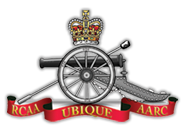
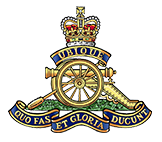
1. As uniforms were simplified to meet the demands of modern warfare, it became apparent that the full achievement of the gunner badge was too large. Beginning with the introduction of the peaked forage cap in 1907, abbreviated versions of the full achievement have been adopted for day to day use. In 1926 the word “Canada” was replaced by the motto “Ubique” in the RCA badge.

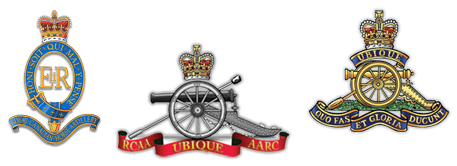
2. The badge of The Royal Regiment of Canadian Artillery is shown at Figure 3. The RCA badge is used both as a cap badge and as a crest. The Colonel Commandant approved the design and colour of the RCA badge on 22 February 1961.

3. The RCHA badge is shown at Figure 4. This badge is only used by RCHA units and associations as a crest. The RCHA badge is based on the badge of the Order of the Garter which dates from 1348. The motto of the Order of the Garter, “Honi soit qui mal y pense” (“Evil be to him who evil thinks”), is not considered as a motto of the artillery. The background colour, including the centre of the garter is the colour of the material on which the crest is mounted. The Colonel Commandant approved the design and colour of the RCHA badge on 22 February 1961. This badge may be used on RCHA unit flags, plaques, stationary, silverware, and decals. When it is displayed with the RCA badge, the RCHA badge shall take precedence.

RCA Badge      RCHA Badge

Figure 3 - The RCA Badge                Figure 4 - The RCHA Badge

4. Use of the RCA and RCHA Badges

    a. use of these Badges on official correspondence is restricted to The Director of Artillery, the Colonel Commandant, The Commander Home Station, RHQ RCA, other RCA HQs and by Commanding Officers of RCA/RCHA units and independent sub-units. The badges may be used on private correspondence and on products sold through unit kit shops provided the badge is displayed in good taste;

    b. the RSM RCA will, on behalf of the Director, establish a policy on the use of the badges and will ensure that units adhere to this policy; and

    c. Units will use only graphics of the badges that are provided by RHQ RCA. Both designs are based on originals prepared by the College of Arms in 1949 as reproduced in The Journal of the Royal Artillery, Vol. LXXVII, No 1, January 1950.


405. The Grenade

1. The grenade, like St. Barbara, has a common heritage with all those who work with explosives and pyrotechnics - artillerymen, engineers, grenadiers and fusiliers. The word grenade derives from the ancient French “pomme grenate” or pommegranate. Heraldically, the grenade is depicted as a sphere spouting flame. The relation to the pommegranate is retained in the orifice-like appendage from which the flame spouts.

2. The grenade was first worn by gunners in the mid-1880s as both a collar badge and a cap badge on the coloured field service (wedge) cap. The grenade used was the universal grenade (Figure 5) which was also worn by the engineers and by several fusilier regiments. In 1907 a revised grenade was adopted with a more stylized flame and “Canada” in a scroll underneath. At this time the convention was established to depict the artillery grenade with seven flames. The Engineers adopted a grenade of the same pattern but with nine flames. The Fusiliers retained variations of the universal pattern grenade.

3. At the time of the adoption by The Royal Regiment of Canadian Artillery of the “Ubique” motto in 1926, that motto replaced “Canada” on the scroll beneath the grenade (Figure 6). With minor variations in size and material the grenade continues in use today as the collar badge of The Royal Regiment of Canadian Artillery.

Universal Grenade      RCA Grenade


406. Colours

1. Traditionally, the colours of The Royal Regiment of Canadian Artillery are its guns. They serve the same central role in pride and identity as do the guidons or colours of armour and infantry regiments.

2. The custom of the guns being the colours of the artillery has its origin in the British practice of designating the largest piece in an artillery train as the “flag gun”. This gun was accorded the honour of carrying the equivalent of today’s Queen’s Colour. Use of the flag gun has been recorded as early as 1722. Later, the guns themselves came to be regarded as the colours of the artillery as gunners in battle rallied to their guns in the same fashion as regiments of cavalry and infantry rallied to their colours.

3. The introduction of rockets and missiles has in some cases changed the nature of the artillery’s equipments. Consequently, the term “guns” shall be deemed to include all weapon systems of the artillery, other than small arms, used to inflict damage or casualties on the enemy. Thus, rocket and missile launchers, despite not being inscribed with the Royal Cypher, will be accorded compliments when they are on ceremonial parade with formed artillery units or sub-units.

4. Compliments are not paid by the troops on parade to the guns during roll pasts or other parade movements. The artillery has no equivalent to the “Trooping the Colour” ceremony. It should be noted that spectators will pay compliments to the guns, as colours, during a roll past or during similar movements on formal parades and ceremonies.

5. Although it may be impracticable in modern times to treat guns as colours in nonceremonial circumstances, they must be accorded the dignity and respect they deserve. Such practices as smoking on or near the guns, sitting or leaning on them, decorating them for social occasions and leaving them unprotected are intolerable.


407. The King’s Banner

1. In November 1904 King Edward VII presented banners to the Royal Canadian Field Artillery and the Royal Canadian Garrison Artillery. It was His Majesty’s pleasure to present these banners to commemorate the service of C, D and E (Special Service) Batteries during the Boer War.

2. The banners were officially presented by the Governor General, Lord Minto, in a ceremony on Parliament Hill. A similar banner was also presented to the Royal Canadian Regiment. The banners were accorded the honours of colours but did not supplant the guns as the colours of the Regiment.

3. The original King Edward VII Banners have not been paraded for many years. Only one remains, and it is in safekeeping in the RCA Museum. Because of its fragile state, it is no longer loaned out to units. The RCA Battle School had a replica banner made, and in 1997 received permission from the Colonel Commandant to parade it at the Battle School’s disbandment ceremonies. The replica banner was subsequently presented to the RCA Museum for safekeeping. The replica banner may be paraded on memorial parades and other special occasions with the permission of the Colonel Commandant through RHQ RCA. The commanding officer of a unit parading the replica banner will ensure that the parading unit affords the banner the honour of a guidon or colour. It is also customary that spectators pay compliments to the banner the same honour as a colour. The Banner does not supplant the guns as the colours of the Regiment.


408. The Royal Canadian Artillery Standard

1. The Royal Artillery Standard was approved by the Colonel-in-Chief, HM King George VI, in 1947. Major General H.O.N. Brownfield, CBE, MC, CD, then Colonel Commandant, applied in 1956 for permission for the adoption of the Standard by The Royal Regiment of Canadian Artillery. The Master Gunner warmly welcomed this proposal, St. James’s Park (then Field Marshall, the Viscount Alanbrooke, KG, GCB, OM, GCVO, DSO) and permission was gladly given. The Royal Artillery Standard was used as the Standard of The Royal Regiment of Canadian Artillery until 31 May 1989. The Standard is reproduced in colour in RCA Notes No. 43, 1947 and in black and white in Army Headquarters letter, HQ 1175-1/3 (D Arty) dated 14 May 1956 and in A-AD-200-000/AG-000 Flags, Ensigns, Colours, Pennants and Honours for the Canadian Forces.

2. On the recommendation of the Artillery Council of 29 April 1988, the Director Ceremonial on 31 May 1989 revoked the authority for units and sub-units to place formation and unit badges, designators, devices and traditional crests on the RCA Standard. At the same time, the Director Ceremonial approved the addition of a gold maple leaf in the centre of the field between the gun badge and the first white diagonal, and the addition of the seventh flame to the grenade. This version is the current approved Royal Canadian Artillery Standard (Figure 7).

RCA Standard

3. The Royal Canadian Artillery Standard is intended for ceremonial use only. It is not carried on parade. It is not broken and shall be flown from flagpoles. The occasions when it will be flown are at the discretion of artillery commanders, but in general will be:

    a. visits of royalty;

    b. visits and inspections by the Colonel Commandant or artillery officers of brigadier-general rank and above;

    c. visits by the Director of Artillery;

    d. visits of allied artillery officers of comparable rank;

    e. visits and inspections by the Governor-General and by Lieutenant-Governors; and

    f. regimental birthdays, St. Barbara’s Day, Artillery Day and Canada Day.

4. On such occasions, the Standard may be flown at all artillery headquarters including formations, units, sub-units and artillery schools.

5. The Colonel Commandant may fly the Royal Canadian Artillery Standard at his residence on special occasions.

6. The RCA Standard is produced in three sizes. All are available from the RCA Kit Shop:

    a. Small

      (1) Size. 5 1/2" x 20", and

      (2) How used. Used as the Colonel Commandant’s distinguishing flag;

    b. Medium

      (1) Size. 1' x 4’, and

      (2) How used. Indoor parades or on small flag poles; and

    c. Large

      (1) Size. 2’ x 8', and

      (2) How used. On larger outdoor flagpoles (30' to 35').


409. The Artillery Flag

1. The Artillery Flag is used as a camp flag in garrison and bivouac to mark the location of artillery units. It may be flown at headquarters, camps and bivouacs daily from sunrise to sunset. It will not be carried on parade. This use of the flag is in accordance with regulations published in A-AD-200-000/AG-000 Flags, Ensigns, Colours, Pennants and Honours for the Canadian Forces.

2. The Artillery Flag is bisected horizontally. The upper half shall be dark red and the lower half a dark blue colour. The RCA badge in gold is in the centre of the flag. RCHA units shall use the RCHA badge, in full colour. See Figures No 8 and 9.

3. The normal size of the Artillery Flag is six feet long by three feet in breadth. A smaller version, three feet long by two feet in breadth is also authorized.

4. The RCA and RCHA Flags are available from the RCA Kit Shop.

Flags


410. Artillery Pennants

1. Artillery pennants are authorized for use by field officers and above who are commanders of sub-units, units, or formations (never flown at RSM or BSM levels). In order that all gunners and outside agencies readily recognize command position within The Royal Regiment of Canadian Artillery, all vehicle pennants, within the Regiment, will be standardized in accordance with A-AD-200-000/AG-000 Flags, Ensigns, Colours, Pennants and Honours for the Canadian Forces.

2. The following instructions will apply to the production of vehicle pennants for RCA units:

    a. Dimensions. All vehicle pennants will be seven inches in width by twelve inches in length with a one inch white sleeve attached to the hoist. Two one-half inch grommets shall be attached one-half inch from the top and the bottom of the sleeve;

    b. Colour scheme. The upper half shall be dark red and the lower half a dark blue colour. All lettering and numbers shall be white in colour and their size shall not exceed one and three quarter inches in height except where there is a requirement to stack numbers or letters. The minimum acceptable size shall not be less than one inch in height. Pennants shall be sewn double sided;

    c. Official Languages. The language used in word and abbreviations shall be the working language specified in the unit’s CFOO. Bilingual units may use either language as decided by the CO; and

    d. Identification. Certain staff officers and commanding officers of regiments, schools or independent batteries shall be identified in the following manner:

      (1) Director of Artillery by the full achievement of the badge embroidered in colour and centred on the pennant,

      (2) COs of RCHA units by the RCHA badge embroidered in gold on the pennant and the number of the regiment clearly displayed in the canton,

      (3) COs of RCA units (except Air Defence) by the RCA badge embroidered in gold on the pennant and the unit number clearly displayed in the canton,

      (4) COs of Air Defence units by the crossed gun barrel and missile superimposed over a vertical lighting bolt embroidered in Gold on the pennant and the unit number clearly displayed in the canton,

      (5) the CDA’s pennant shall conform in colour, material and overall size. It is shaped in accordance with the Brigadier-General’s pennant described in Annex A to Chapter 3 of A-AD-200-000/AG-000 Flags, Ensigns, Colours, Pennants and Honours for the Canadian Forces. It may be described as a swallow-tailed pennant with truncated bottom with the fly cut at centreline to a depth of 5 cm. It carries a centred gold maple leaf and the Divisional number centred in the canton,

      (6) the G3 Artillery pennant conforms in all respects to the standard pattern and bears a centred gold maple leaf, and the alpha-numeric combination “G3”, with the Divisional number below it, centred in the canton,

      (7) the guidelines in sub-para 3 applies to the RCAS with the addition of “RCAS” attached to the fly of the pennant,

      (8) independent batteries shall follow the guidelines for Commanding Officers with the addition of the abbreviation “Bty” or “Bie” attached to the fly,

      (9) regimental seconds-in-command of RCHA units shall fly the white horse centred on the pennant with the number of the regiment displayed in the canton,

      (10) regimental seconds-in-command of RCA units shall fly the abbreviated “2IC” or “CMDT A” over the number of the regiment in the canton,

      (11) battery commanders of RCHA gun batteries shall fly a horse of the appropriate battery colour centred on the pennant with the applicable battery letter, in white displayed in the canton. Battery colours are as shown at Annex A. Battery Commanders of headquarters and services batteries shall fly a white horse and the abbreviated “HQ” or “CS” over the number of the regiment in the red field, and

      (12) battery commanders of RCA gun batteries shall fly the number of their battery displayed in the canton. Battery Commanders of headquarters and services batteries shall fly the abbreviated “HQ” or “CS” over the number of the regiment in the red field.

3. Units can purchase the proper pennants through special order from the RCA Kit Shop at minimal cost. A master roll of approved pennants is shown at Annex A (note: not incl in this version - contact RHQ RCA for details).


411. The Corps Colour Of The Royal Regiment

1. The corps colour of The Royal Regiment of Canadian Artillery is red. It is a deeper shade than scarlet but lighter than cherry. Blue has traditionally been the colour of an artilleryman’s coat. The reason for this has been lost to historical record but it has been suggested that blue was a preferable colour due to the dirty nature of working with black powder guns, and that cavalry and infantry alone were entitled to wear the royal scarlet being the servants of the sovereign. Artillerymen, being originally the civilian employees of the various officials of the ordnance, did not enjoy this privilege and so adopted the sister colour of blue. This distinction was eventually recognized and perpetuated when clothing regulations were formalized, with blue being generally accepted as belonging to the artillery.

2. The corps colour, red, is not used on full dress or mess dress. The correct colour is the distinguishing colour of the Artillery, which is scarlet. The distinguishing colour is used for facings, cuffs, trouser stripes, busby bags, and similar applications. These applications of scarlet reflect the traditional royal facings on artillery uniforms and have nothing to do with the corps colour.

3. The Artillery uses red over blue on regimental flags, standards, pennants, signs, and wherever else artillery colours are required. The colours are a direct extract from the British Flag and are referred to as Union Jack Red and Blue.

4. Information on the proper colour and material for the production of flags, pennants, standards, etc, are available from RHQ RCA.

(412 to 499 inclusive – not allocated)

  • Standing Orders Chapter 5 Drill and Ceremonial