The tradition of a unit of artillery in the region goes back to 1862, when Batteries No 3 and No 4 of Garrison Artillery (Voluntary) of Lévis were formed. The following year, these batteries were modified to field artillery to support the infantry of the voluntary militia. The Lévis companies remained independent, while those of Quebec were unified under one command. In 1864, all of the companies were amalgamated under the Provisional Garrison Artillery Battalion. The changes continue when the companies of Lévis are detached from the provisional battalion in 1867 to become the 1st and 2nd Batteries of Lévis.
With the departure of British troops in 1871 and the creation of the first Canadian permanent force, several members of the Lévis and Quebec batteries joined one of the first units of the Canadian Forces, "B” Battery. The batteries of Lévis continue their training and subsequently join together as No 1 Battery of Lévis (Voluntary). Reorganization occurs again in 1893 when the No 2 Company of Lévis Garrison Artillery (voluntary) is formed.
The "6th Quebec and Levis Regiment, Canadian Garrison Artillery" is created on August 1, 1899 following the reorganization of the Quebec and Lévis independent batteries of garrison artillery. Commanded by lieutenant-colonel George S. Vien, the Regimental headquarters is established in Lévis with four sub-units; 1, 2, 3 and 4 batteries. These batteries are formed from existing units such as the No 1 and No 2 Companies of Garrison Artillery of Lévis which become respectively the 1st and 2nd batteries of Garrison Artillery (Voluntary). The Quebec Company of Garrison Artillery (Voluntary) is divided in order to form the 3rd and 4th Batteries of Garrison Artillery (Voluntary). The 6th Regiment composed of four batteries equipped with 40 pounder muzzle loaders.
In 1911, the "6th Quebec and Levis Regiment" is converted into a unit of coastal defense and renamed the "6th (Quebec and Levis) Coast Regiment Canadian Artillery". The regiment is composed of three coastal defense sub-units; 1, 2 and 3 companies of not-permanent militia, with the regimental Headquarters occupying the new built military Armoury in Lévis.
During the First World War, the mobilization plans are completely restructured, with new units created to take part in the conflict in Europe, while the existing units are not mobilized. However, the "6th (Quebec and Levis) Regiment of Canadian Garrison Artillery" is brought into active service in September 1914 to defend the St. Lawrence River. The Regiment settles in Beaumont at the height of Martinière where two coastal defence batteries were arranged before the conflict, with an observation post i installed at Midsummer's Day on the island of Orleans. During the winter, the ice prevents naval activity; the Regiment is able to carry out other tasks. Certain Lévis gunners enrol in "No 6 Company Royal Canadian Garrison Artillery" which is formed to defend Port Castries in the island of Sainte-Lucie. Towards the end of the conflict, the regiment returns to the pre-war routine of training not-permanent militia to officers and gunners in the area.
In 1925, the regiment is equipped with heavy artillery and re-named "6th (Quebec and Lévis) Coast Brigade Canadian Artillery". The Companies No 1(Lévis), 2 (Lévis) and 3 (Quebec), are renamed the 57th, 58th and 59th heavy Batteries. In addition, a 3rd section of anti-aircraft artillery is created and attached to this brigade. During the period 1922 to 1935, the "6th (Quebec and Levis) Coast Brigade" is distinguished during the national competitions by gaining several prestigious prizes.
Another reorganization occurs in 1936, as the unit becomes the "6th (Quebec and Levis) Medium (H) Brigade, RCA." The sub-units become field artillery batteries. The designation (H) indicates the unit is equipped with 6 inch Howitzers. The "57th Medium Battery", "58th Medium Battery" and "59th Medium Battery" are maintained and adopt their new role, while the 3rd section of anti-aircraft artillery is expanded to become the "3rd Anti aircraft Battery, RCA."
When the Second World War is declared, the "6th (Quebec and Levis) Medium Brigade" is not mobilized as an organization, but its sub-units receive specific tasks and several of its members are deployed overseas.
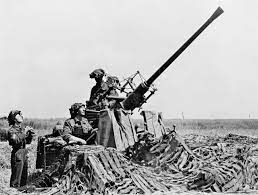
The "57th Medium Battery" is mobilized in November 1939 and is reorganized as an Anti-aircraft battery. It takes part in the defense of England against German fighters and bombers. In 1942, it takes the name of "57th Light Anti Aircraft Battery (French speaking)". This sub-unit is dissolved in 1944, when its members are combined with the "4th Medium Regiment" on the front where several other members of the "6th (Quebec and Levis) Medium Brigade" are serving.
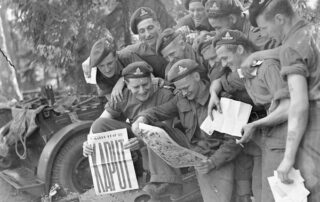
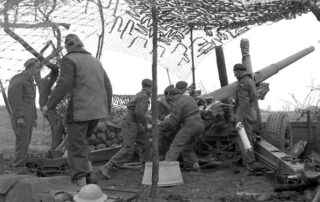
The "58th Medium Battery" is mobilized on July 29, 1941 to serve in the "20th Regiment, RCA" with the "50th Battery" of Montreal and the "72nd Battery" of Coaticook. The "20th Regiment" is a French-speaking unit and is trained in Valcartier. In 1942, it is transferred to Petawawa and becomes the "4th Medium Regiment RCA." the 258th battery of this unit perpetuates the tradition of the 58th battery mobilized in Lévis in 1941. The "4th Medium Regiment" fires its first shell against the enemy on July 13, 1944 and takes part in the battles of France, Belgium and Germany in support of the 1st Polish Armoured Division. The regiment distinguishes itself throughout the campaigns; while several former members from the "6th (Quebec and Levis) Medium Brigade” receive several decorations and promotions.
The "59th Medium Battery" is reorganized in 1939 to become the "59th Heavy Battery" and mobilized on August 28, 1939 to defend the Town of Quebec against any marine invasion. The battery occupies the Fort of Martinière, its First World War emplacement. Huts and new permanent batteries are arranged. During the winter 1940, the battery leaves Beaumont for Halifax and occupies defences of Strong McNab. In April, the battery is back at the heights of Martinière and increases its manpower. The most important contribution of the 59th battery during the war was the training of officers and gunners who will disperse to the four corners of Canada for coastal defence, a continuation of the defence of the Port of Quebec.
The "3rd Aircraft Battery" is mobilized on August 26, 1939 and is reorganized to become the "17th Battery Air-Defense" and tasked to defend the industrial and energy complex of Arvida. In 1942, the "12th" and "41st anti-aircraft Batteries" join the "17th Battery" to form the "24th Air Regiment Defense" commanded by Lieutenant-Colonel J.R. Samson, formerly of the "6th (Quebec and Levis) Medium Brigade." In 1943, the "17th Air Battery Defence" departed Arvida in order to defend the strategically important allied airport of Gander, Newfoundland where it remained until the end of the war.
With the end of the war, several units are demobilized and, on the 1st April 1946, the unit is designated the "6th Field Regiment, RCA." This unit is made up of three sub-units; the "58th", "59th" and "80th Field Batteries". The "57th Medium Battery" having been dissolved during the war, is replaced within the unit by the "80th Field Battery." The "3rd Air Defense Battery" is renamed the 203rd light Anti-aircraft battery of the 63rd light anti-aircraft Regiment. The peacetime routine begins again for the gunners of the unit. The regimental Headquarters moves successively from Quebec and Lévis.
On May 1, 1951, the 58th Battery is mobilized to serve with the "79th Field Artillery Regiment” which is activated in order to support the Canadian brigade in Europe, within the framework of the North Atlantic Treaty Organization (NATO). After one year of active service, the majority of the Lévis gunners return to the country, but the battery remains with the "79th Field Artillery Regiment" which is redesignated the "3rd Royal Canadian Horse Artillery Regiment" in November 1953. Some original members of the Lévis battery are deployed with "3 RCHA" when this unit is deployed to Korea in May 1954.
Major changes occur in 1954, when the 35th anti-tank Régiment is amalgamated with the "59th Field Battery" of the "6th Field Regiment." In addition, the 132nd anti-tank battery is amalgamated with the "80th Field Battery” and the 145th Anti-tank battery is amalgamated with the "82nd Field Battery" of Gaspé. The latter is assigned to the "6th Field Regiment" as a fourth sub-unit. At the same time, the "57th Locating Battery" of Quebec is dissolved. With the numeral 57 once again available, the 80th battery is renamed in order to take on the tradition of the 57th Battery within the Regiment.
In 1960, the "6th Field Regiment" is renamed to "6th Field Artillery Regiment, RCA." In 1964, the 59th battery is relocated to the Montmagny Armoury which was formerly occupied by a company of the Fusiliers du Saint-Laurent. In 1965, the 82nd Battery in Gaspé is reduced to nil strength.
On September 1, 1970, the "6th Field Artillery Regiment" is renamed the 6e Régiment d’artillerie de campagne (RAC) with three batteries: 57th Battery, 58th Battery and 59th Battery, and the regimental headquarters located at the Lévis Armoury. In 1984, at the time of its 85th birthday, the regiment was granted the Freedom of the City of Lévis, by its Mayor, Mr Vincent Chagnon.
On September 19, 1992, the 58th Battery was reroled as an anti aircraft artillery Battery, renamed 58e Batterie d’artillerie anitaérienne and relocated to the Grande-Allée building in Canadian Forces Base Valcartier.
The Regiment was again reorganized during the Army Reserve Restructure that introduced Army Reserve Establishment (ARE) tables. On April 1997, 59e Batterie and 57e Batterie are amalgamated as one mission element of 6e Régiment d'artillerie de campagne ARC. 57th Battery is located in Montmagny in order to better serve the members of the battery who live in the region of Lévis and Montmagny. During this time, the Regiment shows its professionalism by its performance as a field artillery regiment during Land Force Quebec Area evaluations held in 1997 and 1998.
On May 16, 1999, during the opening of its regimental 100 year birthday festivals, and to underline 35 years of its presence in Montmagny, the 6th Field Artillery Regiment was granted and exerted for the first time, the freedom of the city in Montmagny.
The task of the 6e Régiment d'artillerie de campagne ARC is to provide a field artillery battery if need be, to reinforce the le 5e Régiment d’Artillerie légère du Canada. In order to carry out that task, the Regiment must train its soldiers and gunners in their individual battle task standards. In addition, the unit conducts several live firing artillery practices, usually in Base Valcartier. The mission element uses the 105mm howitzers C3 and conducts from 4 to 5 live firing practices annually, in addition to conducting regimental exercise with the other artillery units in the Area, both reserve and regular component. In May 2000, the Regiment provided nearly 20 members of all ranks to deploy with 5e RALC on Exercise INTREPID LION in Gagetown for a period of more than one month.
During its 100 years of existence, the 6e Régiment d'artillerie de campagne ARC has provided a great number of gunners for the permanent force and the Canadian Forces, and has distinguished itself during service on all fronts. That service includes Europe during the two World Wars, assistance to the nation in a domestic capacity such as the deployment to the North-West in 1885 or the recent ice storm of 1998, and participation on various missions of the United Nations and NATO. During the five last years, the Regiment deployed more than 60 soldiers and officers on operations such as Danaca (Israel), Recuperation (ice storm), Alliance (Ex-Yugoslavia), Stable (Haiti) and Palladium (Ex-Yugoslavia). The 6th Field Artillery Regiment has an excellent reputation within the Canadian artillery. Its soldiers and officers are recognized for their technical professionalism and their knowledge.
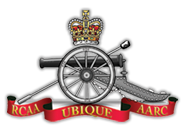
The armorial bearings of the regiment, which were adopted on June 5, 1904, are made up of the coat of arms of the town of Lévis, surmounted by a helmet of knight resting on a gun of garrison, surrounded of a beam of English flags and fleurs-de-lisés with the words pronounced by the Knight of Lévis on the Sainte-Hélène island in 1760 while referring to its guns: TO RETREAT... NEVER.