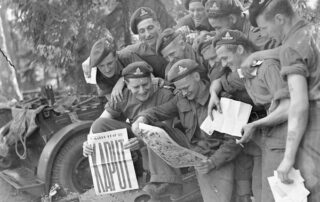
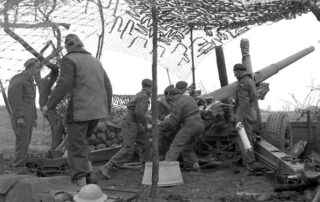
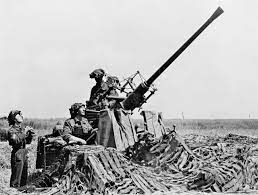
2 RCHA was formed in Shilo on 7 August 1950 for United Nations Service in Korea. It consisted of D, E and F Batteries and RHQ, and was equipped with the 25-pounder gun. On 21 November 1950, while en route to the USA for preparatory training, 17 soldiers were killed and 42 injured in a train collision at Canoe River, near Valemount, British Columbia. Memorial cairns were erected at Shilo and Valemount in memory of those killed. 2 RCHA arrived in Korea and fired its first rounds in action on 17 May 1951. During its year of war in Korea, 2 RCHA fired close to 300,000 rounds as part of 25 CIB and, later as part of Commonwealth Division Artillery. Five soldiers were killed in Korea and 31 received bravery and meritorious service decorations.
On return to Canada in 1952, the regiment was stationed at Fort Osborne Barracks, Winnipeg. In June 1953, it provided the Sovereign’s Escort at Queen Elizabeth’s Coronation in London, England. On 17 August 1953, Y Battery was formed as the regiment’s light battery, equipped with 4.2 inch mortars. In November 1953, the regiment, less Y Battery, moved to Fort Prince of Wales in Deilinghofen near Hemer, Germany, for NATO services with 4 CIBG.
2 RCHA returned to Winnipeg in 1955 where it remained until January 1964. In 1956, its 25-pounders were replaced by the 105mm C1, and Y Batteries 4.2 mortars were replaced with the 155mm M114 towed howitzer.Z Battery, with the M114, was attached to 2 RCHA from 1957 to 1964. In 1958, T Battery was formed as the regiment’s locating Battery, and Y Battery was disbanded.
In 1964, 2 RCHA returned to NATO duty to Fort Prince of Wales. The regiment gained an Air OP Tp with three L-19 aircraft. Because the NATO establishment required only three 105mm Batteries, T and Z Batteries remained in Canada and soon disbanded. In 1965, F Battery converted to the 115mm M114 towed howitzer.
On completion of its Germany tour in 1967, 2 RCHA moved to Gagetown. The following year, F Battery was reduced to nil strength as part of a general force reduction; the remaining D and E Batteries converted to the 155mm SP M109. In July 1970, RHQ and D Battery moved to Petawawa and converted to the 105mm L5. E Battery remained in Gagetown and finally joined the Regiment at Petawawa in 1975. In 1977, E Battery was redesignated E Battery (Para), and a Blowpipe AD Troop was added to the regiment. This troop existed until 1987, when low level air defence units were formed. The regiment received the Freedom of the City of Kingston in 1983, and of Cobourg in 1987. The regiment served in Cyprus from September 1985 to March 1986.
On 1 October 1987, F Battery was re-formed in cadre strength. Y Battery was re-formed, from 7 July 1991 to 4 October 1992, as an air defence battery equipped with the Blowpipe and Javelin missile systems. The regiment replaced 1 RCHA in Cyprus in March 1993, becoming the final Canadian unit to serve on the island.